
Table of Contents
Cast in Steel 2027
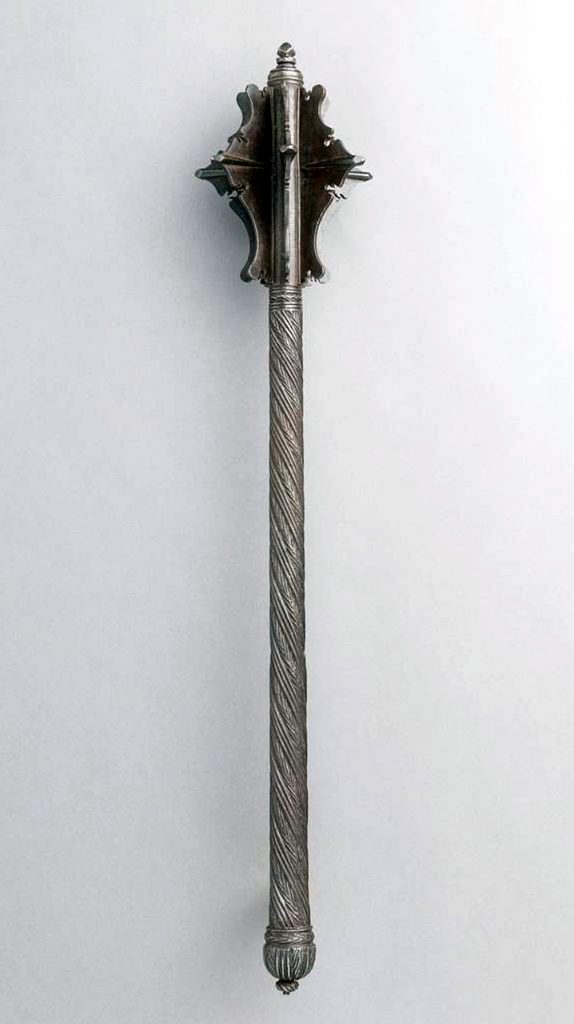
Registration is open for student teams to compete in Cast in Steel 2027, which will be held April 22nd – 24th in Cleveland, OH, immediately following the AFS Casting Congress. Teams will be challenged to design and cast a flanged mace. The flanged mace was among the most formidable close-combat weapons of the late Medieval period. Engineered to defeat heavy plate armor, its rigid shaft and flanged steel head concentrated tremendous impact into a small area, delivering crushing blows capable of denting, deforming, or penetrating protective armor.
If your foundry is interested in being an industry mentor to work with a team, please contact Renee Mueller: [email protected]. An industry mentor is an excellent opportunity to connect with the next generation of metalcasters. For more information, visit: castinsteel.net
GRAND PRIZE: $25,000
IMPORTANT EVENTS & SUBMISSION DATES
Friday, January 15, 2027 Registration Deadline.
Friday, March 19, 2027 Project video, technical report, and authenticity report are due.
Friday, March 19, 2027 Flanged mace shipped by.
April 22-24, 2027 Cast in Steel performance testing in Cleveland, Ohio
More info: castinsteel.org
Cast in Steel Season One (2025 competition featuring George Washington’s Sword)
All six episodes of Cast in Steel are now available to watch anytime onYouTube!
If you missed an episode or just want to relive some of the exciting moments, you can now catch up on the entire series whenever it’s convenient for you.
Future Leaders Meeting
The upcoming meeting of the Future Leaders group will be in Winona, Minnesota September 9-10. The meeting will have an operations focus, with presentations from Peter Macler, George Hartay, Paul Rudd, Ed Kaczmarek, Steve Cooke, and Joe Plunger, as well as a roundtable discussion for attendees and a tour of Midwest Metal Products (tour policy below). If you have any questions, please reach out to Tory Wendlandt ([email protected]).
SFSA Tour Policy: Steel foundry tours are an important value of SFSA membership. The tours are intended to provide an opportunity for sharing technical and operating ideas. A benefit to the host is the feedback of the attending founders who can provide their unique expertise on what they saw as opportunities for improvement or clever innovations. Attendees shall not use the tours as a means to acquire customer, parts or staff. Attendees shall participate in the meeting related to the tour and have a related job function to the purpose of the meeting. Attendees shall reciprocate by offering a tour to the host foundry when requested. If circumstances do not permit a tour when requested (i.e. customer visit already planned, plant shutdown, key personnel out of the plant), every effort should be made to support a visit at the next requested time. The host foundry may limit the number of attendees for multiple reasons including size of facility, available tour leaders, etc. The host foundry may exercise first right of refusal if an attendee is from a major competitor; however, this cannot be done if the visit is a reciprocal visit. Declining the attendance of any SFSA member should only be done when absolutely necessary. Attendees should try to bring their own PPE to minimize the burden on the host. Attendees shall abide by all safety and other rules of the host foundry.
SFSA Safety Awards
It is time to participate in the SFSA Safety Award Program! To be eligible for safety awards, participants must report a safety record DART for 2025 that is equal to or less than 1.7. This is the composite average for all manufacturing industries. We will be awarding “Perfect” and “Outstanding” awards.
If you’re 2025 DART rate is 1.7 or lower, you need to fill out the online application no later than September 11, 2026 to be eligible for a safety award. Member companies achieving a safety record less than or equal to 1.7 will receive a certificate; companies achieving a perfect record with a DART Rate of 0 will receive a plaque. Safety award recipients will be recognized during the SFSA T&O Conference in December.
Apply here: https://www.surveymonkey.com/r/SFSA_SafeT_26
80th Technical & Operating Conference
The T&O Workshop and Conference will be December 9-12 in Chicago. This year will feature a special workshop on sand control Wednesday morning.
Market News
Manufacturing & Industrial Markets Outlook
Source: ITR Economics
ITR reports that the economic outlook improved modestly in August, with upgrades to their forecasts for heavy-duty trucks, metalworking machinery, and defense capital goods. Heavy-duty truck production is recovering faster than previously expected, with double-digit growth forecast for 2027. Metalworking machinery is benefiting from investment in AI and data centers, aerospace and defense, and increased automation in response to skilled-labor shortages. Defense orders also received a significant 2026 upgrade and are expected to remain historically strong as replenishment and capacity expansion continue.
The broader U.S. economy remains resilient, with real GDP growing at a 2.1% rate, supported by consumer spending and capital investment. Capital investment remains strong but is increasingly concentrated in AI infrastructure, data centers, power generation, high-tech manufacturing, and defense.
Globally, conditions are progressing largely as expected, with most major economies now producing above year-ago levels. Mexico remains in recovery but is expected to return to year-over-year growth by the end of 2026. Inflation remains relatively persistent across the Americas and Europe, keeping most central banks cautious about lowering interest rates. Recent improvements in some leading indicators suggest global growth could remain resilient somewhat longer than anticipated, although 2027 is still expected to be softer.
SFSA Market Forecast
The SFSA Marketing Committee is working on the 2027 SFSA Market Forecast. The committee would appreciate receiving your input on the markets that you serve in support of the forecast. Please take a moment to complete the market forecast survey: https://www.surveymonkey.com/r/4cast2027. Responses are kept confidential and will be aggregated with other member responses.
SFSA Business Trends
To benchmark your facility with other steel foundry members, SFSA encourages you to participate in the monthly SFSA business trends survey – only participants have access to the results. Please complete the business trends survey for July 2026: https://www.surveymonkey.com/r/SFSA_BTB_Jul26. Survey results are provided to participants the following month.
| STEEL FOUNDERS' SOCIETY OF AMERICA BUSINESS REPORT | ||||||||||
|---|---|---|---|---|---|---|---|---|---|---|
| 12 Mo Avg | 3 Mo Avg | June | May | April | ||||||
| Department of Commerce Census Data | ||||||||||
| Iron & Steel Foundries (million $) | ||||||||||
| Shipments | 1,959.4 | 2,087.3 | 2,088 | 2,104 | 2,070 | |||||
| New Orders | 1,987.8 | 2,094.7 | 2,088 | 2,167 | 2,029 | |||||
| Inventories | 3,323.3 | 3,371.7 | 3,380 | 3,380 | 3,355 | |||||
| Nondefense Capital Goods (billion $) | ||||||||||
| Shipments | 91.0 | 93.9 | 95.1 | 93.6 | 92.8 | |||||
| New Orders | 97.6 | 102.9 | 98.1 | 96.6 | 114.1 | |||||
| Inventories | 249.9 | 251.9 | 252.5 | 251.8 | 251.5 | |||||
| Nondefense Capital Goods less Aircraft (billion $) | ||||||||||
| Shipments | 79.1 | 81.9 | 83.1 | 81.4 | 81.3 | |||||
| New Orders | 80.1 | 84.2 | 85.4 | 84.4 | 82.8 | |||||
| Inventories | 185.3 | 186.6 | 187.0 | 186.5 | 186.3 | |||||
| Inventory/Orders | 2.3 | 2.2 | 2.19 | 2.21 | 2.25 | |||||
| Inventory/Shipments | 0.0 | 2.3 | 2.25 | 2.29 | 2.29 | |||||
| Orders/Shipments | 0.0 | 1.0 | 1.03 | 1.04 | 1.02 | |||||
| American Iron and Steel Institute | ||||||||||
| Raw Steel Shipments (million net tons) | 7.8 | 8.0 | 8.1 | 7.7 | 8.2 | |||||
Casteel Commentary
Right parts, right time. No company is immune to the challenges of doing this consistently. It is also not a problem specific to castings. I have seen high volume, simple shape material from a well-regarded aerospace-quality mill show up at a forge shop with holes in it. Clearly something went wrong. And even additive parts produced from the same metal on the same machine do not net perfect parts every time. So, what would it take to make an order of castings without any unexpected processing so they can ship on-time with the quantity ordered to the quality required?
The question is not specific to stage in production or quantity. For instance, this could be for a first article, or for a part that only a few are ordered and then it does not get ordered again until another five years, or it could be for a part that 100 are ordered weekly. It is not related to “repair” welding, which is a poorly used term as foundries do not weld castings that “broke”. As recognized by standard bodies such as ISO and AMS, welding by the foundry is both necessary, such as welding a core print, but also for optimizing manufacturing constraints to best meet a customer’s performance requirements. So, welding as planned processing does not drive missed ship dates. It is also important to know that all steel is cast. As porosity or inclusions may be artifacts in all steel, it is important to discern them from the word “defect”. Quality Details (size, shape and location) can be considered by the customer through a fracture mechanics design methodology for any product form to provide Fitness For Purpose – ensure part performance based on what Quality Details matter.
Quality Detail – This term is used with purpose instead of defect, discontinuity, feature, flaw, anomaly, etc. ASTM defines a defect as being something one needs to inspect for and that exceeds a stated criterion. Furthermore, calling something a defect when it does not make the part defective is poor association. The use of other words proves problematic as they often depend on relative size to be considered. Therefore, the term Quality Detail accurately defines the need to assess something that is a relatively small, a detail, that may or may not be acceptable to the stated criteria of a part, the quality.
So, what would enable our industry to make the most meaningful progress in achieving the goal of the right parts at the right time?
The first challenge starts with defining requirements and what happens if original parameters are poorly thought out or communicated. If initial parameters for a part are not thought out, both specific requirements and unspecified actual expectations, parts simply cannot be made to unknown requirements. Adding to this challenge is low volumes, which limit applying six sigma – when your order is six parts, these concepts lack application. If the original requirements are not correct the spec may never be consistently met. For instance, setting a NDT level that is below the probability of detection will always result in parts not meeting a requirement.
One of the easy solutions is a true partnership between producer and purchaser with clear requirements and open communication. A kick-off meeting facilitates concurrence that specs are reasonable, review of critical areas including any past problems, and design discussion on tolerances, directional solidification/soundness, and taper/radii. Foundry pre-production such as casting simulation, gantt with management reserve, dimensional pattern layout plus production review with customer and management approval is essential. A project manager helps support production flow, parts meeting requirements and direct communication with customer if deviation occurs. One historical strategy by customers would be to dual source or purchase extras to ensure parts were available when needed. The foundry is an eager and willing partner as reducing unplanned rework and scrap are disruptive to production planning and reduce margins.
Design for manufacturability is a must. Collaborative design between the customer and foundry, such as reducing isolated sections, creates parts that can best be manufactured to all the requirements. Knowing machined features is critical. Foundry engineering is a balance between the processes at a given foundry, productivity and resources to ultimately achieve requirements. Small design changes such as increasing fillet sizes or ribs in fit-to-air geometry, reduce stress that cause cracks. Adding stock to features which can be machined off if needed before shipping can be a strategy to improve castability. Historically, redline drawings were created for these allowances; however, loss of subject matter expertise and not having these changes formally documented directly affects future manufacturability. Dimensions can be one of the most common challenges. Using proper GD&T concepts and tolerances for the casting process used are essential. The use of functional gauges for datum targets and scanners with Model Based Definition (MBD) can assist in producing the complex geometry of castings. SFSA has a range of webinars, whitepapers and resources to assist customers in understanding, designing, specifying and purchasing steel castings:
- Steel Casting Design & Manufacturing Webinars
- Specifying Steel Castings
- Purchasing Steel Castings – Source Selection
- Product Development and First Article Qualification
- Developing New Steel Casting Suppliers
- Solid Models and Dimensional Tolerances
- Welding Steel Castings
- Test Coupons and Casting Properties
An easy answer to the question is to replace old and outdated equipment, but key is sustained profitability to enable this. Equipment that lacks the capability to produce the required quality or dimensions on every part or that breaks down, affecting production schedules, is problematic. Innovation in the equipment is another need. Due to globalization, our industry has survived partly through cannibalization, which means equipment gets recycled instead of growth pushing equipment advances. Automation and robots provide an opportunity but only if they work for job shop manufacturing.
Margins to support a workforce is critical to getting parts right – everyone from the molder to the metallurgist. Having the resources to invest in personnel to do project management, quality improvement, artisan training, etc. are important to making things right and on-time. Related, capacity is also a factor. At a recent meeting, Anduril talked about buying their way to the front of the line for an urgent need. However, this likely resulted in others not getting what they expected on-time and planning with management reserve can only get you so far. When a manufacturer relies on outside services, they are beholden to that supplier staying on-time and properly doing the required job. Also, as many castings are machined before use, the advantages of enabling the foundry to do at least rough machining is important to consider.
Automation provides a side benefit of consistency be it for manufacturing processes or helping to improve the Gage R&R of NDT. Final inspection and shipping typically are not high on a list when thinking of quality or production lead-times. However, when final inspection identifies a short fill on an impeller vane two hours before the shipping truck shows up, it becomes an emergency and disruption to send the part back through production. Recently, SFSA worked on a part detection project to be an automated overcheck – ensure the right parts and quantity get sent to the right customer, averting simple human error creating a disruption. Pushing this technology further upstream can facilitate demand planning, work instructions and activity-based costing.
Achieving good parts when expected comes down to communication, good first article development, knowing process capability, and management and executing processes. Variability can seem endless, yet the industry has managed this to produce high performance castings daily. The industry does this through good foundry practice and people, using expertise specific to each part made, and following the detail. While production processes may be inherently prone to variability and six sigma principles are built around high volume production, there are methods that can be applied to reduce error and maximize first pass success. Decades ago, SFSA developed Project 80 on the unusual ways to reduce cost, which led to analysis of variance for continuous process improvement. Additional member references:
- Research Report 78.pdf
- Special Report 9.pdf
- SFSA Project 80 – 50 Years Later
- Problem Solving Techniques
These same techniques coupled with Industry 4.0, simulation and best practices such as clean steel can serve to reduce rejects. A greater solution comes through Industry 4.0 and leveraging the tremendous amount of real-life experience already accumulated by the end user. Decades of field experience, failure analyses, maintenance records and operational feedback must be better integrated into the reject discussion. If the objective is to understand which Quality Details truly matters, then the customer’s service experience should be one of the most valuable sources of information available. Too often, foundries focus on manufacturing and inspection data while remaining disconnected from actual service performance.
Design, metallurgy, process control, simulation, NDT and now AI are often treated as separate initiatives, while in reality they are all part of the same problem and should be connected within a common framework. With advanced inspection tools, the fundamental goal should not be to detect more indications, but to understand which Quality Details matter. Too often, acceptance criteria are driven by perceived risk and the unknown. Specifying zero defects in any product form is simply beyond the probability of detection, and this “perfect” material becomes unobtanium with an excessive and unnecessary cost.
Operational Technology (OT) such as the Internet of Things (IoT) does afford the ability to aggregate processing conditions, which can be related to characteristics that drive part performance and can ensure lower bound functionality. This technology can also help to manage processing to deliver these parts on-time and provide a feedback loop to improve probabilistic modeling software. It can also provide a resource for developing best practices and capture tribal knowledge plus training and constructive support for a new workforce. Vision systems for NDT will promote consistency and quality levels can be tied to quantitative performance. AI likely has many future roles, but one should be monitoring process data including videos.
The objective would not be to replace engineering judgement but to augment it and make it more consistent. This represents a shift similar to the transition from deterministic thinking to probabilistic thinking. Traditional foundry practice often seeks a simple pass/fail answer. The future may instead require us to think in terms of risk, probability and confidence levels. It is perhaps not unlike the conceptual transition from classical computing to quantum computing: not replacing certainty where it exists but recognizing that complex systems are often best understood through probabilities rather than absolutes.
Beyond the technical challenges, this may also require new financial and organizational thinking. Cybersecurity and rapidly changing technology will affect a foundry just like metallurgy, manufacturing and managing the business. It certainly would appear there is a new foundry frontier, but this does not displace the need and value of good communication.
David Poweleit