Table of Contents
Members’ Lunch and Roundtable Discussion at Metalcasting Congress in April
SFSA is pleased to invite members and special guests to join us for lunch on Tuesday, April 14th from 11:30 a.m. to 1:30 p.m. at Bistro Bella Vita, 44 Cesar E. Chavez Ave SW, Grand Rapids, Michigan, just a short walk from the DeVos Convention Center.
For $55, you’ll enjoy a delicious meal while connecting with fellow SFSA members. Following lunch, we’ll begin the roundtable discussion, providing an excellent opportunity to share insights and ideas with peers.
Registration and payment are required to reserve your spot, so please be sure to register soon. Registration closes on March 23rd.
Hope you will join us for this great opportunity to network, collaborate, and connect.
If you have any questions, please contact Renee at rmueller@sfsa.org.
SFSA EHS/HR Meeting – April 29-30
Please plan to attend the SFSA EHS & HR Group Meeting on April 29–30, 2026 at the Holiday Inn in Pewaukee, WI. This meeting provides an excellent opportunity to learn from peers and exchange ideas and includes a seminar on leadership training that will provide practical takeaways to help you develop your future leaders.
Agenda and Registration: https://sfsa.site-ym.com/event/EHS-HR2026
Research Review, July 7-9
Please make your plans to participate in the annual SFSA Research Review on July 7-9. This year’s meeting will be held in-person in Rosemont, IL. The Review covers the latest in both Carbon & Low Alloy and High Alloy steel casting research under the AMC and STAR programs. The meeting is also your opportunity to interact with the researchers and provide industry steering. The event vets our research portfolio to select the R&D projects to be featured at the National T&O. More details regarding registration and the Design Day are to come. For any questions, contact Caelan Kennedy (ckennedy@sfsa.org).
Additional Keel Bars Needed
To support the development of the SFSA carbon & low alloy atlas, we are looking for additional standard keel block legs:
- 1010, 1045
- 4120, 4130, 4140
- Any carbon level for the 13XX, 46XX, or 51XX alloy families
SFSA is developing a carbon & low alloy atlas to show the effect of alloying elements and heat treating on the mechanical properties and microstructure of low alloy steels. As-cast and bars from same heat would be preferred, and if you can pour at least 10 from the same heat that is even better. Heat chemistry or mechanicals would be appreciated, but not required. Please contact Caelan (ckennedy@sfsa.org) or Tory (tory@sfsa.org) for shipping details.
Specification Committee
SFSA is actively involved in American Society for Testing and Materials (ASTM), International Organization for Standardization (ISO), Boiler and Pressure Vessel Code (BPVC), and American Welding Standard (AWS). The specification bodies foster collaborative development of commercial standards, which SFSA will work with to transition technologies into new or existing standards. These efforts are led by our Specification Committee, which will meet on May 5th in Dallas, TX. For more information, please contact Dave.
NASCC
SFSA will be exhibiting at the North American Steel Construction Conference (NASCC) to promote the use of castings in steel construction.
The building construction conference, NASCC, will be April 22-24 in Atlanta, Georgia. SFSA’s partnership with AISC, has enabled the use of steel castings for North American buildings to no longer be a novelty, but more opportunity for our industry awaits. This year marks several achievements and near-term accomplishments:
Members can receive an exhibit pass for Thursday, April 23. RSVP with Caelan (ckennedy@sfsa.org) by March 6.
80th Technical & Operating Conference
The T&O Committee is in the process of setting up this year’s conference. It will be December 9-12 at the Loews Hotel in Chicago. If you would like to recommend a topic and presenter, please contact Dave.
Cast in Steel Competition
We are thrilled to invite you to the 2025 Cast in Steel Competition, featuring the Horseman’s Axe! This year’s event promises to be more exciting than ever, with 62 teams from 36 universities, mentored by 38 industry partners, going head to head to test their axes.
The Horseman’s Axes will be on display during the MetalCasting Congress at the DeVos Convention Center, 303 Monroe Ave. NW, Grand Rapids, MI. They will be displayed in the Chase Board Room on the second floor on Tuesday, April 14 from 9:00 a.m. to 4:00 p.m.
The Cast in Steel TV series competition and award ceremony will take place at Grand Valley State University’s Innovation Design Center, 227 Winter Ave. NW, just a short walk from the convention center.
Competition
Wednesday, April 15: 11:00 am-5:00 pm
Thursday, April 16: *TBD
Friday, April 17: *TBD
*Exact start and end times for Thursday and Friday will be announced at the end of the previous day, as the schedule depends on how far we progress.
Awards Ceremony
Friday, April 17: *TBD (after testing)
RSVP
If you are plan on attending the competition, please RSVP to Renee Mueller at rmueller@sfsa.org so we can be sure to have enough seats and lunches for everyone.
New this year, following the competition, SFSA will auction off the axes. The proceeds from the auction will directly benefit the participating schools.
Once again, our sponsor is the Industrial Base Analysis and Sustainment (IBAS) Program, managed by the Innovation Capabilities and Modernization (ICAM) Office in the Office of the Assistant Secretary of Defense for Industrial Policy (ASD IBP).
| UNIVERSITY | FOUNDRY NAME |
|---|---|
| Arizona State University | ME-West Castings |
| Arkansas State University | Southern Cast Products |
| Baylor University | Delta Centrifugal |
| California Polytechnic State University, Pomona (2 teams) | Soundcast Co. |
| California State Polytechnic University, Pomona | Aerotec |
| California State Polytechnic University, Pomona | Miller Foundry |
| Central Michigan University (2 teams) | Bay Cast Inc |
| Colorado School of Mines (2 teams) | Western Foundries |
| Ferris State University | Eagle Alloy, Inc. |
| Georgia Southern University | Georgia Southern University, N/A |
| Georgia Southern University (4 teams) | Carolina Metal Casting |
| Georgia Southern University | Carolina Metal Casting |
| Grand Valley State University | Eagle Alloy |
| Grand Valley State University | Eagle Precision Cast Parts Inc |
| Herron School of Art and Design, IU Indianapolis | Harrison Steel Castings Company |
| Louisiana Tech University | Howell Foundry |
| Michigan Technological University | Bay Cast Inc |
| Michigan Technological University | Temperform |
| Michigan Technological University | Aalberts Surface Technologies |
| Mississippi State University | Southern Cast Products |
| Missouri University of Science and Technology | Missouri University of Science and Technology |
| Missouri University of Science and Technology | Caterpillar |
| Missouri University of Science and Technology | Southern Cast Products |
| Penn State Behrend | Ashland Foundry & Machine Works |
| Pittsburg State University | Monett Metals |
| Purdue University | Kimura Foundry America |
| Purdue University WL | Waupaca Foundry, Plant 5 |
| Rose-Hulman Institute of Technology | Harrison Steel Casting Company |
| Tennessee Tech University | Magotteaux |
| Texas State University (3 teams) | Henderson Manufacturing Co. |
| The Ohio State University | Fisher Cast Steel |
| The University of Alabama | Southern Alloy |
| Trine University | Bahr Brothers Manufacturing |
| Universidad Autonoma De Nuevo Leon | Fundiciones Lerma S.A de C.V |
| University of Alabama at Birmingham | Andritz |
| University of Northern Iowa | UNI Metal Casting Center and Factory 4.0 Center |
| University of Northern Iowa | Wisconsin Precision Casting Corporation |
| University of Tennessee-Knoxville (2 teams) | Magotteaux |
| University of Wisconsin - Madison | MetalTek |
| University of Wisconsin - Milwaukee (3 teams) | MetalTek |
| University of Wisconsin Platteville | MetalTek |
| University of Wisconsin - Madison | Signicast |
| Virginia Tech | Midwest Metals |
| Wentworth Institute of Technology (3 teams) | DW Clark |
| Youngstown State University (2 teams) | Trumbull Foundry and Alloy |
Casting Dreams
The 2026 Competition has officially closed, and what an incredible journey it’s been!
With 35 organizations and schools and over 1,200 young people participating, Casting Dreams has truly inspired the next generation of casting talent.

A huge thank you to everyone who helped make this opportunity possible for the students including educators and mentors to partners and supporters. Your dedication and encouragement helped create an unforgettable experience for the students.
The castings will be on display during the MetalCasting Congress at the DeVos Convention Center, 303 Monroe Ave. NW, Grand Rapids, MI. Stop by the Chase Board Room on the second floor on Tuesday, April 14 from 9:00 a.m. to 4:00 p.m.
The Nationals Award Ceremony has a new date and will take place on Tuesday, April 14 at 10:00 a.m. in the Chase Board Room at the DeVos Convention Center. We look forward to celebrating with everyone there.
Be sure to stop by the Chase Board Room on the second floor to see the incredible castings submitted by these talented students. It is a great opportunity to experience the creativity and skill these young participants have put into their work. We hope to see you there!
Market News
ITR reports that capital goods orders are outperforming expectations, signaling continued business investment. Capex growth is a mixture of higher volume and higher prices. Overall economic activity is expanding across most sectors, but growth in 2026 is expected to remain mild to moderate. The US Total Industry Capacity Utilization Rate ticked up in January. The broader trajectory is positive, indicating that modest increases in the US Industrial Production should persist through at least the middle of this year.
Overall manufacturing conditions are trending toward mild-to-moderate growth, though performance varies by segment. Construction machinery, defense equipment, and civilian aircraft production are showing relative strength. Broader tailwinds—including electrification, expansion of digital infrastructure, and ongoing geopolitical tensions—are supporting growth across several manufacturing sectors. In contrast, ITR revised down their forecasts for heavy-duty trucks, medical equipment, and light vehicle production. The recovery in heavy-duty truck production continues to be delayed due to elevated inventories and weak demand.
SFSA Business Trends
To benchmark your facility with other steel foundry members, SFSA encourages you to participate in the monthly SFSA business trends survey – only participants have access to the results. The quarterly data will no longer be included in the Casteel Reporter. Please complete the business trends survey for February 2026: https://www.surveymonkey.com/r/SFSA_BTB_Feb26. Survey results are provided to participants the following month.
Casteel Commentary
An effort to restore the ship building industry and to secure the national defense capability has identified the casting and forging industry as a concern. This concern is shared by the energy community for economic security. The ramp up in production in defense equipment has struggled. Long lead times, missed schedules, and ongoing concerns over product quality have supported the more costly alternatives like Additive Manufacturing (AM) as a potential supplement or replacement. This is being advocated even with the severe cost penalty of qualifying or using those alternatives. Casting and forging suppliers have asserted that the challenge is not in our capability to meet the production schedule but the acquisition system that is burdened by legacy requirements and commercial practices that create the delays and concerns.
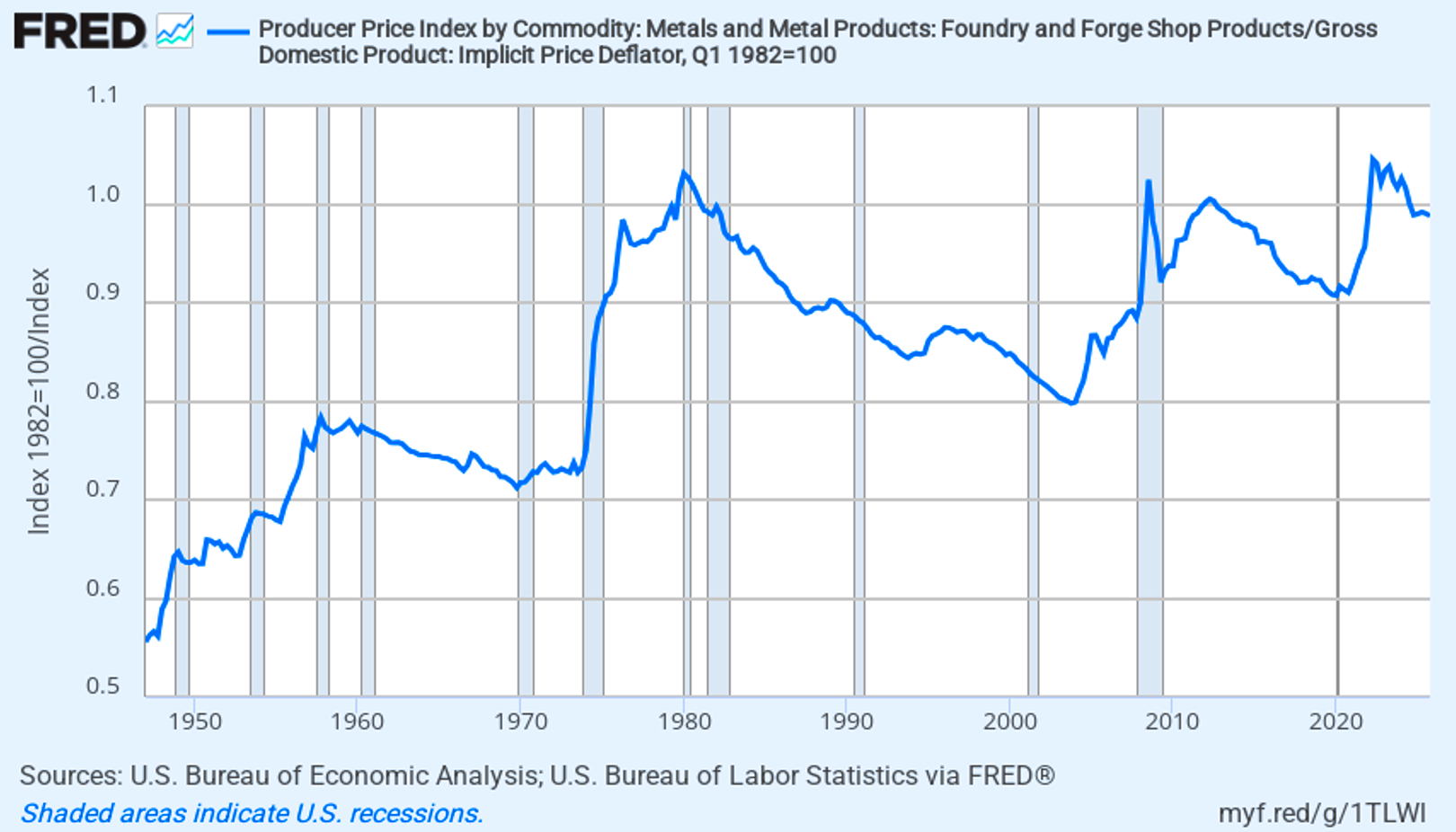
Does our industry have a lack of capacity to meet the current requirements? Our plants say no, while our customers and their customers seek alternative suppliers. One way to see if the industry is lacking in capacity is to look at movements in real pricing or value shown in Figure 1. Nominal prices may be increasing but if they are lagging inflation, the value of our products is less.
If the steel casting and forging industry are lacking capacity, that should be reflected in changes in prices. The casting and forging industry was capacity limited during the building of the capital infrastructure during the 1970s as seen in the sharp increase in value in Figure 1.
As a necessary supplier that needed to invest and modernize to supply needed products, our purchasers wanted us to be profitable enough to support needed production. Since there was a limited supply, if the purchaser was unwilling to allow that level of profit, the producer found other customers. Most producers had backlog schedules that were months not weeks. In 1979, 2,030,000 tons of steel castings were made in the U.S., but by 1982 only 780,000 tons were made. This resulted in the 20% decline in value of steel castings from 1980 to 2003.
The decline from 1980 to 2003 was the liquidation of excess capacity. In markets with excess capacity, purchasers can negotiate pricing down to the direct cost of production. The market clearing price is tied to the cost and only the low cost most efficient plants are able to survive. This excess capacity was not only or primarily due to drops in domestic demand but included the globalization that reduced our customers purchases as they lost global market share. To survive, our domestic customers drove our prices below the profit levels needed to maintain and modernize. When the liquidation of 1999 to 2003 occurred and global economies expanded, capacity was no longer adequate and prices rose sharply.
The market clearing price when capability is limited is not based on the cost of production but on the value of the product to the purchaser. The volatile markets since 2000 have pricing fluctuate from normal excess capacity based on the cost of production plus a modest profit, to liquidation prices to have the cash flow to remain in business, to much higher prices as purchasers chase capability to meet their schedules and needs. The value of castings and forgings like most custom parts is roughly twice the direct cost of production. Special critical casting and forgings have costs that exceed the cost of production by more than a factor of two even during down turns due to the added costs of testing, qualification and delays from the purchaser.
As seen in Figure 1. the product value increase of 20% regained the value at the peak of 1979 in 2014 before another decline of 10% ending during Covid in 2020. The industry was at our capability with the current plant configuration, product mix and workforce from 2021 to 2023. The limit of industry capacity exceeds any current industry capability since our production limits are not the major capital equipment capacity but the other factors mentioned; product mix, plant configuration and workforce.
Current purchasers of steel castings and forgings are concerned with pricing and risk. They use their position to drive down the pricing to minimize cost and this has the intended effect of limiting the profitability of the supplier. This is making producers less capable to meet the current or future requirements. When an individual supplier is late and in conflict with the purchaser, the purchaser may attempt to find an alternative source. Castings and forgings are custom proprietary parts and producers are not hardware stores.
This makes developing a new supplier for a different product more involved than making a commercial contract. Unfortunately, without having an established relationship, the lead time from contact to supply with a new supplier is long. Purchasers and program managers experience the inability for the acquisition system to meet the production schedule as a lack of capacity and capability in the casting and forging industry. Lead times for new products is not a good measure of capacity.
Many existing customers for complex large engineered castings and forgings do not have the same challenge of supply because they approach producers with a developed schedule, a purchase commitment for their project well ahead of the scheduled need. One way to see that the casting industry is not capability limited is in the reported backlog in Figure 2.
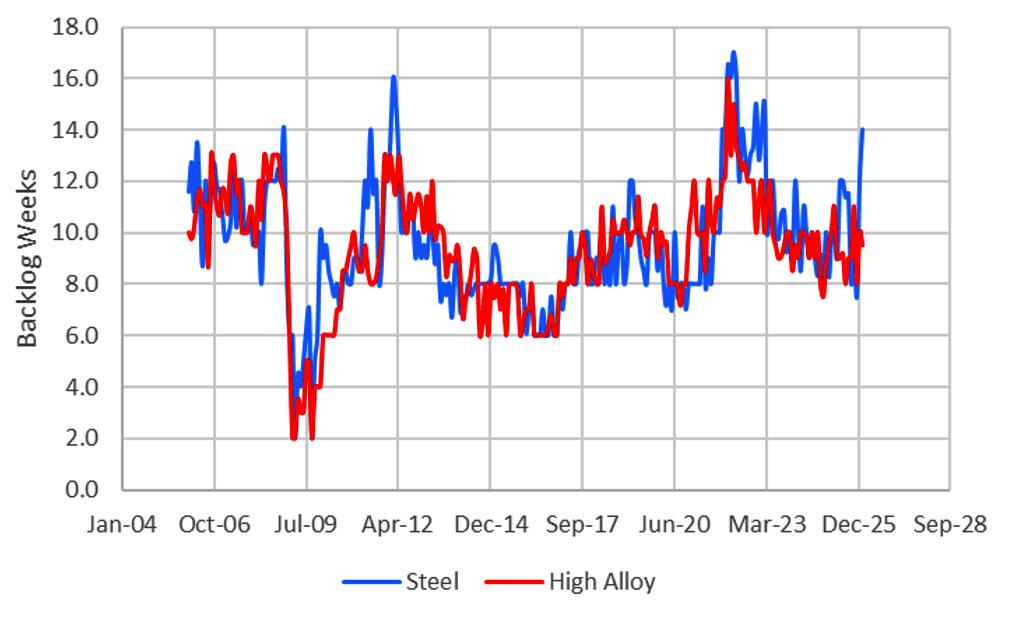
Backlog in normal business conditions is 8 to 10 weeks. Sharp declines in demand reduce the reported backlog to 6 to 8 weeks. After these sharp declines, purchasers need to refill their supply for work in progress and meet delayed purchases that keep the infrastructure functioning. Backlogs can exceed 12 weeks. The volatility seen in the graphs post 2000 has made investment and survival challenging.
Purchasers who need critical engineered castings need to develop a long-term collaboration with their casting and forging suppliers. These arrangements need a meaningful purchase commitment to allow the profitability needed for the producer to invest and support the schedule and requirements. Purchasers chasing lower costs at the expense of their critical suppliers in this area will find it challenging to meet their schedules for their customers.
Alternative suppliers like AM have a role to play, especially in new product development. Casting and forging producers are using AM to accelerate the production of new designs to allow testing and validation.
The existing framework of legacy market dominant firms driven by cost and risk will need to give way to aggressive modern firms that prioritize speed and performance. This shift can be seen in the movement from NASA to SpaceX. The infrastructure systems required for national and economic security need investment for the future, but it must be driven not to reduce risk but to optimize performance.
Casting and forging suppliers have needed capability but will need purchasers and their customers to make the structural changes needed to partner and support the investment and profitability needed.
Raymond
| STEEL FOUNDERS' SOCIETY OF AMERICA BUSINESS REPORT | ||||||||||
|---|---|---|---|---|---|---|---|---|---|---|
| #colspan# | 12 Mo Avg | 3 Mo Avg | December | November | October | |||||
| Department of Commerce Census Data | ||||||||||
| Iron & Steel Foundries (million $) | ||||||||||
| Shipments | 1,836.30 | 1,936.70 | 1,980 | 1,927 | 1,903 | |||||
| New Orders | 1,854.60 | 1,948.70 | 1,980 | 1,989 | 1,877 | |||||
| Inventories | 3,284.60 | 3,291.00 | 3,277 | 3,317 | 3,279 | |||||
| Nondefense Capital Goods (billion $) | ||||||||||
| Shipments | 88 | 89.7 | 90.1 | 88.5 | 90.4 | |||||
| New Orders | 98.9 | 99.8 | 100.6 | 108.6 | 90.2 | |||||
| Inventories | 249 | 248.7 | 249.5 | 248.5 | 248 | |||||
| Nondefense Capital Goods less Aircraft (billion $) | ||||||||||
| Shipments | 76.6 | 78.2 | 78.8 | 78 | 77.8 | |||||
| New Orders | 76.7 | 78.6 | 79.2 | 78.6 | 77.9 | |||||
| Inventories | 183.4 | 184.9 | 185.5 | 184.8 | 184.5 | |||||
| Inventory/Orders | 2.4 | 2.4 | 2.34 | 2.35 | 2.37 | |||||
| Inventory/Shipments | 0 | 2.4 | 2.35 | 2.37 | 2.37 | |||||
| Orders/Shipments | 0 | 1 | 1.01 | 1.01 | 1 | |||||
| American Iron and Steel Institute | ||||||||||
| Raw Steel Shipments (million net tons) | 7.6 | 7.4 | 7.5 | 7.1 | 7.7 | |||||